 Benjy King Studio
Est. 2014 · NY
Benjy King Studio
Est. 2014 · NY
Company History as a Sourcing Signal: How to Read a Supplier's Story
A supplier's history is the first thing a buyer reads and the last thing they should trust on its own. Years in operation, a factory tour, a certificate wall and a client logo page are all signals, and signals are useful for deciding who to talk to, not for deciding who to sign with. What a long history genuinely predicts is the presence of habits that are expensive to build late: batch records, retained references, a routine way of answering customer questions, and staff who have seen a launch go wrong before. What it does not predict is whether those habits are applied to your order, which is a question only project-specific evidence can answer.
Key takeaways
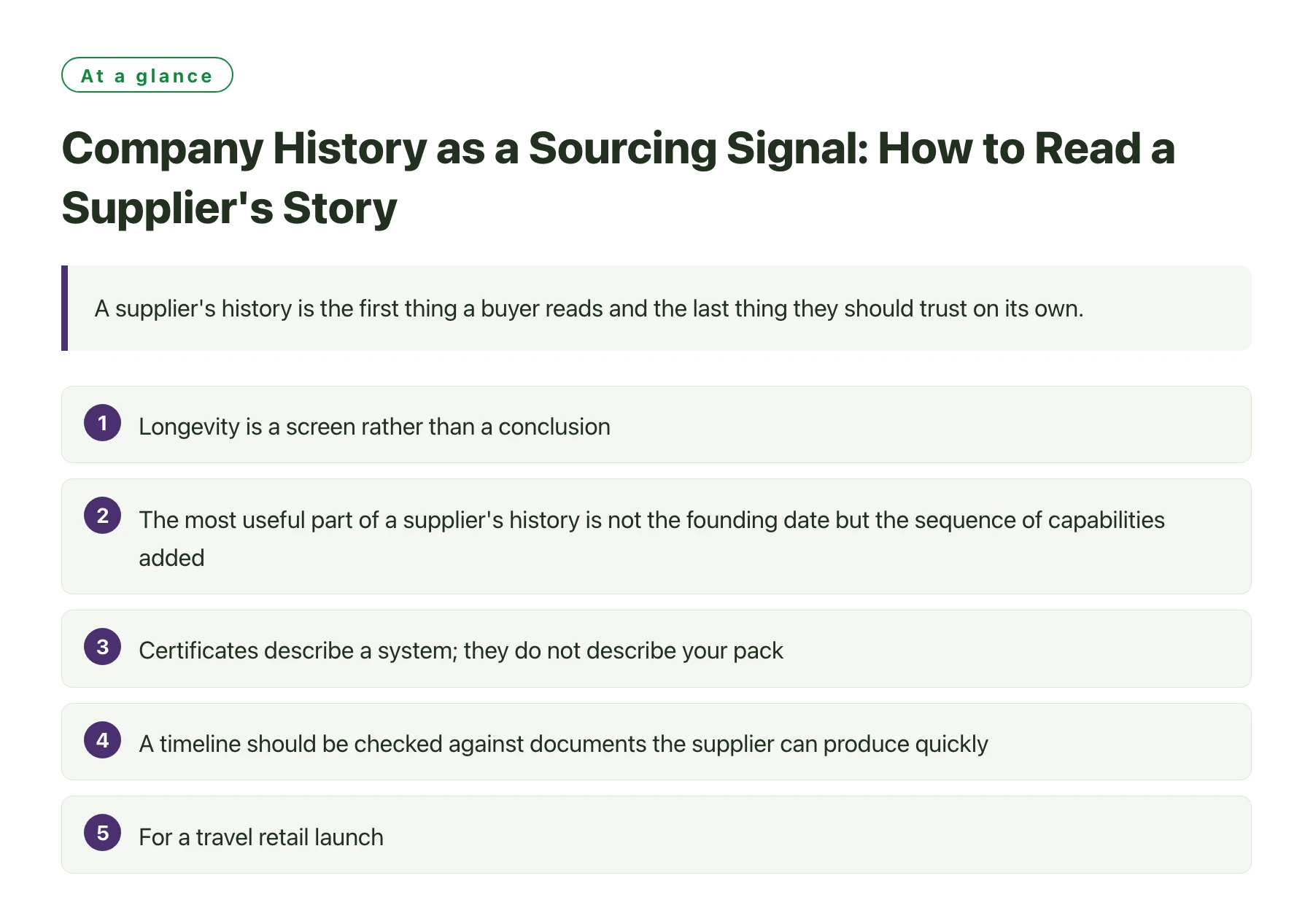
- Longevity is a screen rather than a conclusion, because it predicts institutional habits rather than the quality of a specific project.
- The most useful part of a supplier's history is not the founding date but the sequence of capabilities added, since that shows what the factory has had to learn.
- Certificates describe a system; they do not describe your pack, your claim or your market list.
- A timeline should be checked against documents the supplier can produce quickly, because retrieval speed is itself a quality signal.
- For a travel retail launch, the history question worth asking is how many times the factory has handled a multi-market listing with the same pack, not how many years it has existed.
- Verification of a supplier's claims is a normal procurement step, and independent inspection or testing services exist precisely to close the gap between assertion and evidence [1].
Supplier evaluation usually starts with a story. A manufacturer describes when it was founded, how it grew, which capabilities it added and what it now offers under one roof. That story is genuinely informative, particularly in fragrance, where the skills required to compound, fill, decorate and document a product are built over years rather than bought in a season.
The mistake is to treat the story as the answer. A retailer or an importer will not accept the story either; they will ask for documents tied to the specific product. The buyer who reads the story as a map of what still needs verifying ends up with a far more useful assessment than the buyer who reads it as a verdict.
This is how to separate the parts of a history that predict something from the parts that merely reassure.
Signals, what they suggest, and how to test them
| Signal | What it suggests | How to test it in one step |
|---|---|---|
| Years in operation | Institutional habits around records, references and repeat orders | Ask for a document produced for another project, with commercial details removed |
| Capabilities added over time | The factory has absorbed complexity rather than outsourcing it | Ask where a capability sits physically and who signs off its output |
| Certification set | A management system exists and has been audited by an outside body | Ask which certificate covers the site that will make your product, and its validity date |
| Multiple markets served | Familiarity with differing labelling and documentation expectations | Ask which market requirements the factory routinely handles and which it has never handled |
| Client logos or a case page | Breadth of experience at some point in the past | Ask what the factory did for those projects, since manufacturing and filling are different scopes |
| A public scope description | The supplier has thought about how its offer fits together | Compare the description against the quotation line by line and note what is missing |
| Fast, specific answers | Records and processes exist in a retrievable form | Ask the same question twice, weeks apart, and compare the answers |
The pattern in the third column is deliberate: every signal is converted into a request for something concrete. That keeps the assessment moving and stops a promising first meeting from becoming a decision.
Why a long history still matters, and its limits
Fragrance manufacturing rewards accumulated judgement. A factory that has produced for years has usually seen a formula separate in the cold, a pump stiffen in storage, a decoration fail a rub test and a retailer ask for records that did not exist. Those experiences tend to become procedures, and procedures are what protect a buyer who has not seen them yet.
The limit is that accumulated judgement is institutional, not automatic. It has to be applied. A factory that has handled difficult projects for other customers may still assign a new account to a team without the same habits, or run your pack through a decoration vendor it does not control closely. Verification therefore has to be project-specific even when the supplier's history is strong.
Public material is a reasonable place to begin. A page such as about Xuelei, which sets out a company's manufacturing scope and certification position, is exactly the kind of first screen that tells a buyer whether a second conversation is worth having. It is a claim, plainly, and it should be read as one.
The question a timeline does not answer
A founding date does not say how many times a factory has run a multi-market listing where one unit had to satisfy several labelling regimes. That is the experience a travel retail launch actually draws on, and it is worth asking about directly. The answer may be fewer projects than the timeline implies, which is useful information rather than a disqualification.
Reading claimed capabilities
A scope list written as a sequence of verbs, from development through compounding, filling, decorating and packing, is more informative than a list of adjectives. It gives the buyer something to divide into questions. Where each step happens, who owns the equipment, and what happens when a step fails are all answerable, and the answers reveal how integrated the operation really is.
What to verify before a contract, whichever story you heard
Four items are worth verifying on every project. First, the legal entity you are contracting with. Second, which site will manufacture the product and what its certification position is. Third, who owns the formula and the packaging tooling, and under what terms. Fourth, what documents will be produced and when.
The ownership question deserves more attention than it usually receives, because intellectual property rights are territorial and registration-based rather than automatic. WIPO's materials on intellectual property and business are the standard reference for what can be protected and how rights are transferred or licensed [2]. A brand that assumes ownership without a written position is relying on a story rather than on a right.
The documentation question is easier to test. Industry guidance for cosmetic manufacturing treats records and traceability as part of the production system rather than as an administrative layer [3], so a supplier with a strong system will answer the question quickly and specifically. A supplier that needs to check internally is not necessarily weak, but the delay is information.
Finally, it helps to look at what a supplier says about completed projects. Reading examples of fragrance projects with the question what did the factory actually do here in mind produces a much sharper picture than reading the same page for reassurance.
The practical rule is to let history decide who gets a second meeting and let evidence decide who gets the order. A supplier that has been operating for decades but cannot produce a project-specific document set is riskier than a younger one that can, because the launch will be judged on documents rather than on years. Asking each candidate to compare their own history against how to evaluate a custom fragrance manufacturer is a fair, non-confrontational way to move the conversation from story to substance.
Sources
- SGS: Cosmetics, Personal Care & Household Testing —— Testing, inspection and certification services for cosmetics and personal care, including microbiological, stability and safety testing aligned with cosmetics GMP.
- WIPO — World Intellectual Property Organization —— The UN agency for intellectual property; resources on industrial design and patent protection relevant to product and packaging design.
- Cosmetics Europe —— The European trade association for the cosmetics and personal care industry, publishing guidance, positions and market information.
Frequently asked questions
How much weight should a supplier's years in business carry?
Enough to influence who you shortlist and not enough to skip verification. Longevity suggests that records, references and repeat-order habits are likely to exist, which matters for a multi-market launch. It does not tell you whether those habits will be applied to your specific pack, claim and market list, which is what the due diligence should establish.
Do certifications prove a factory can make a good product?
They prove that a management system has been defined and audited against a standard. That is a meaningful floor, and it is why buyers use certificates as an early screen. It does not evaluate the fragrance, the pack or the project team, so certificates belong alongside project evidence rather than instead of it.
What is the fastest way to test a supplier's claims?
Ask for a document the factory already produced for another project, with commercially sensitive details removed, and watch how long it takes and how complete it is. Retrieval speed and completeness say more about day-to-day systems than any description of them, and the exercise costs the supplier very little.
Should a brand verify who owns the formula before signing?
Yes, in writing. Ownership and use rights are separate matters, and the arrangement is not implied by paying a development fee. Because intellectual property rights are territorial and depend on what has been registered, the position should be recorded in the agreement and understood by both parties before production begins.
What history question matters most for a travel retail launch?
How many times the factory has delivered a unit that had to satisfy more than one market's labelling and documentation requirements, using the same pack. That experience changes how a project is planned, because it forces the market list and pack list to be fixed early rather than discovered during artwork review.