 Benjy King Studio
Est. 2014 · NY
Custom Stainless Steel Jewelry: Sampling to Batch
The gap between an approved sample and a repeatable batch is where most custom orders lose time. CAD is published at under 48 hours, the master sample at 25–30 days, and bulk at 3–4 weeks, which leaves roughly 7–9 weeks end to end. The variable is not the factory clock; it is how many decisions stay open after the sample is signed.
Key takeaways
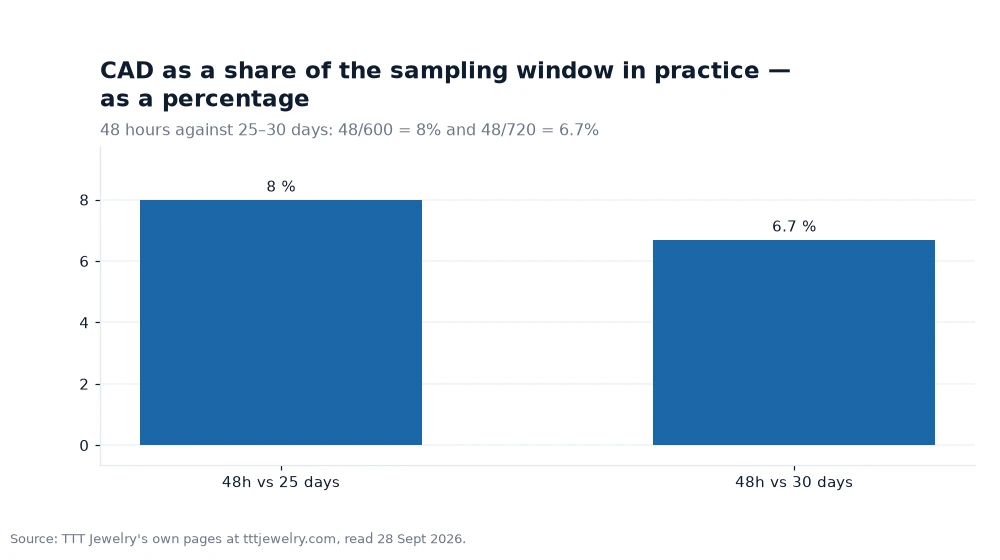
- CAD occupies 6.7–8% of the 25–30 day sampling window: 48 ÷ 720 = 6.7% and 48 ÷ 600 = 8%.
- Stainless runs begin at 100+ pieces per design, so a three-design batch is at least 300 pieces.
- A second sample round adds another 25–30 days, which is why the freeze list matters more than the first sample.
- Bulk production takes 3–4 weeks, or 21–28 days, after the sample is approved.
Sampling is a decision window, not a queue
Buyers often treat the 25–30 days as time spent waiting for a parcel. The factory treats it as a sequence: 3D wax printing, precision mould casting, stone setting, polishing and custom electroplating. Each stage asks a question that the next stage assumes has been answered. If the answers arrive late, the sample still ships, but it ships with guesses baked in.
The CAD step is short by comparison. At 48 hours against a 25-day window, modelling is 48 ÷ 600 = 8% of the schedule; against 30 days it is 48 ÷ 720 = 6.7%. That small share is the least costly place to make a change, because a CAD revision costs hours while a physical revision costs a full sample cycle.
The published route, including the PVD finish options and the 100+ piece floor, is described by this PVD stainless steel jewelry wholesale page.
This is why a serious sampling plan front-loads review. The first three days should settle geometry, the middle should settle finish and setting, and the last week should be reserved for the physical check rather than for deciding what the physical check will test.
Four things a sample has to prove
Fit is the first. A ring that slips, a clasp that opens under light tension or a pendant that hangs off-centre is a design fault, not a finishing fault, and it will repeat across every piece in the batch. Fit is judged on a body or a mandrel, not on a flat image.
Finish is the second. The high-gloss polish, the brushed direction and the PVD colour all have to be seen under the lighting the product will be sold in. A finish approved under a desk lamp can look flat in a photo studio and wrong under a warm retail spot.
Function is the third: the clasp, the hinge, the ear wire and the jump ring are mechanical parts that wear faster than the decorative surface. A sample that opens and closes correctly once has not been tested; fifty cycles by hand is a more honest check.
The fourth is the pack. A backing card that sags, a pouch that is too small for the widest piece or a barcode label that peels in a cold warehouse will all surface after the batch is boxed. The pack is part of the sample, not an afterthought once the metal is approved.
The freeze list
A freeze list is a single page naming every attribute that cannot change without a new sample. For a stainless piece it usually holds eight items: alloy grade, principal dimensions, finish, coating colour, stone or accent, hallmark, chain or finding, and packaging. Each item gets a value and a reference image.
The list is useful because it converts a conversation into a comparison. When a production piece looks slightly different, the question becomes which line on the sheet moved, and the answer is usually findable. Without the sheet, the discussion drifts into taste, and taste cannot be inspected.
Two items are commonly left off and later cause trouble. The first is the alloy grade: 316L and 304 look identical after polishing but behave differently in water, and substituting one for the other changes the product claim. The second is the hallmark position, which interacts with polishing and coating and cannot be moved without reworking the surface.
| Stage | Published window | Decision closed | If reopened |
|---|---|---|---|
| CAD and prototype | Under 48 hours | Geometry and dimensions | New file, new print |
| Master sample | 25–30 days | Finish, setting, function | Another full sample |
| Sample approval | Buyer review | Freeze list signed | Batch held |
| Bulk production | 3–4 weeks | Volume and routing | Line re-sequenced |
| Final QC | 100% inspected | Release against sample | Rework or remake |
Change control after approval
Once the sample is approved, every change has a price in calendar rather than in money. A plating colour change reopens the 25–30 day window because colour is approved on a physical master. A dimension change reopens CAD and possibly the mould. A packaging change is least disruptive, because it usually sits outside the metal workflow, but it can still stop a pack-out.
The practical rule is to batch changes. If three attributes need adjustment, one revised sample can test all three; three separate revisions cost three windows. That sounds obvious, and it is routinely ignored when a brand approves a sample and then sends a list of small comments over the following fortnight.
A second rule is to separate must-fix from nice-to-have. A loose stone is a must-fix because it will fail in wear. A slightly warmer gold tone is a preference, and if the current tone is within the approved standard, changing it buys a sample cycle and nothing else. The approval gates listed by TTT Jewelry exist for exactly this reason: each gate is a chance to stop, not a formality to pass.
A sample is made in ones. A batch is made in hundreds, and the difference shows up in handling rather than in design. Polishing time per piece falls when a bench runs a tray, but the risk of an edge being over-polished rises. Plating racks hold more pieces, so the current distribution across the rack becomes a variable that a single sample never exposed.
Inspection is where volume is most visible. At 100+ pieces per design, a full pass means every piece is handled, and the reject count that looked trivial on a sample becomes a real quantity. That is not a reason to sample instead; it is a reason to fix the process at the first repeated fault rather than inspecting it out at the end.
The batch window itself is published at 3–4 weeks. It is shorter than the sampling window because the decisions are already made. A batch that runs long is usually waiting on a component, a label or an approval, not on the polishing bench.
Worked example
Take a three-design stainless order at the floor: 3 × 100 = 300 pieces. If the buyer requests one revision after the first sample, the calendar becomes 2 days of CAD + 25–30 days for sample one + 25–30 days for sample two + 21–28 days of bulk. That totals 73–90 days, or about 10–13 weeks, against 48–60 days for a single sample pass.
The CAD share shows why the revision is better made early. At 48 hours, the model is 6.7–8% of one sampling window. Redrawing it costs two days; discovering the same issue after a physical sample costs 25–30 days plus the shipping time in both directions.
Volume arithmetic adds the inspection load. Three hundred pieces at 100% inspection is 300 final checks. If two of the three designs need a plating correction on the full batch, that is 200 pieces stripped and recoated plus 200 repeat checks, all inside a window that had no slack to begin with.
Frequently asked questions
How long does the sample stage take for stainless jewelry?
25–30 days for the master physical sample, after CAD modelling that takes under 48 hours. Bulk production then runs 3–4 weeks.
Can production start before the sample is approved?
No. The approved sample is the reference for 100% inspection, so starting bulk first would leave the batch with no standard to release against.
What is the stainless steel minimum for a batch?
100+ pieces per design. Brass starts at 100 per design and sterling silver at 50, so the stainless MOQ is the highest of the three.
Handing over a batch that can be repeated
The most useful handoff is boring: a signed freeze list, a labelled reference sample, a pack specification and a named contact for each question. Boring is the point. It means the batch is measured against a document rather than against someone's memory of a meeting.
Brands planning several metals in one season can keep the same structure and swap the material lines. The custom jewelry wholesale overview sets out the published minimums and options, so the freeze list can be adapted without rebuilding the process for each metal.
Sampling to batch is a version-control problem dressed as a manufacturing one. Freeze the version, test the version, then reproduce it. The factory can only run the batch it was given.
Source note: figures come from the manufacturer's own website (tttjewelry.com), read 28 Sept 2026.[1]